

Monday, September 02, 2013

ROGUE AGENDA: THE DOSSIERS

See The Winners Of The Giant Gummy Bear Contest

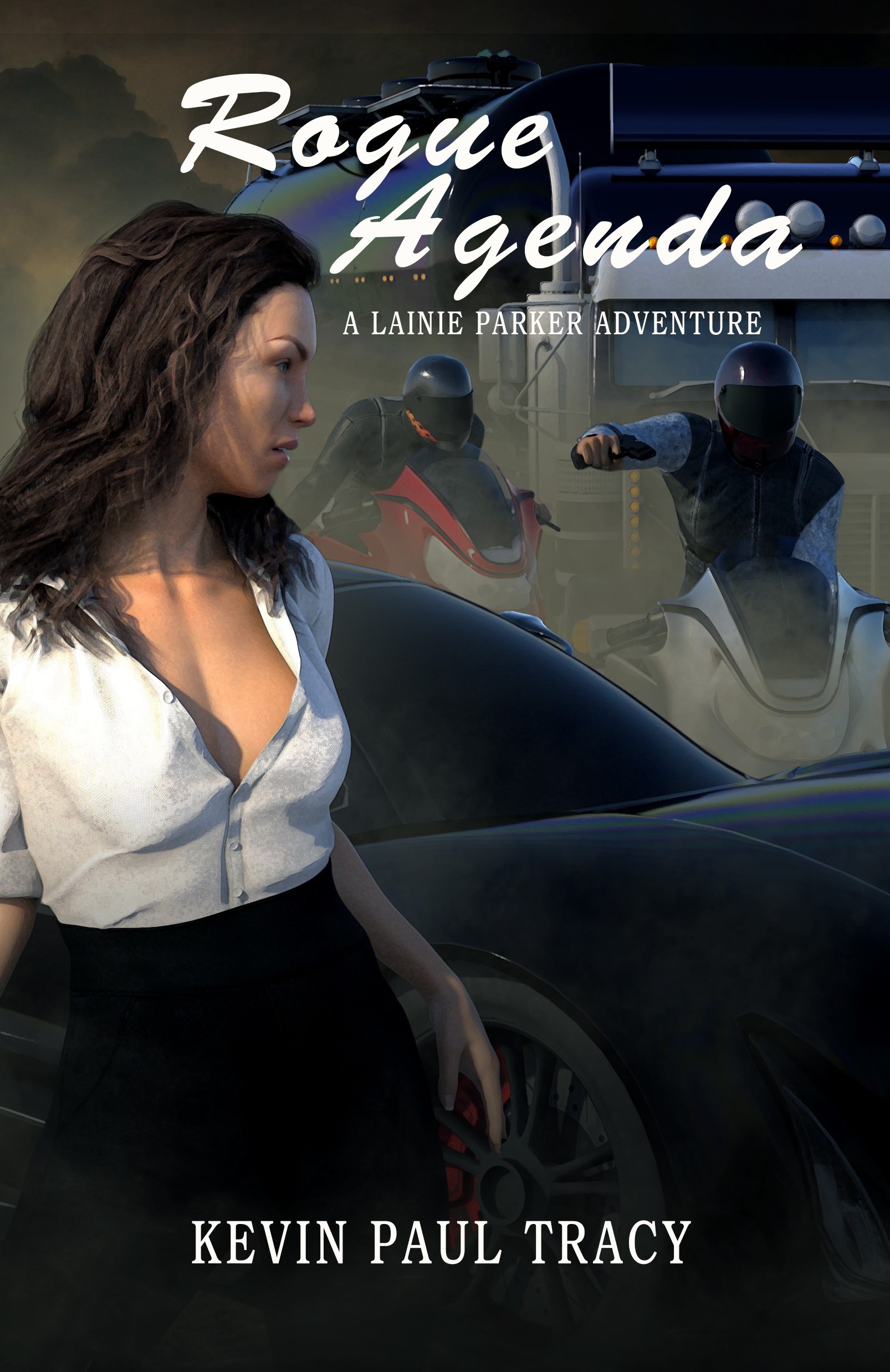
In anticipation of the release of my latest adventure novel, "ROGUE AGENDA," I decided to share the dossiers on some of the key players in the affair, recently declassified by the NSA.

LAINIE PARKER
     The most popular telephone sex talent at Capris Entertainment, 26-year-old Lainie stumbled into the job while looking for a way to offset the cost of college. Now, nearing the final stages of her PhD in Psychology, with a minor in Child Special Education, when Lainie isn't working she's neck-deep in studies and her duties as Research Assitant for the Psy department. While beautiful, smart, and a little sarcastic, she has no time for friends or love, much less running around the country trying to prove her innocence of the charges of arson and murder, hounded by a hulking killer.

SIMI AL-SEHREMNI
     Somewhere in her early twenties, this daughter of renown middle-eastern scientist Faisel Al-Sehremni, is more than meets the eye. On the surface, she's an older sister attending college at New York University more to keep a protective wing over her younger brother, Ibrahim, than to matriculate, herself. But there are many mysteries about this diminutive beauty. For example, from a culture that generally subdues its women, how did she become so strong and independent? Also, for one so young, where did she learn that specialized spinning technique of fighting that makes her an opponent not to be underestimated?

AGENT CORD STEELE, CIA
     Understandably, little is known about this handsome, charming, and enigmatic man - much of this dossier has been redacted. It is known he drives a late-model Lexus convertible with the daring if not the skill of a NASCAR pro, that he has elevated the act of stealth to an art form, and that he wields a spool of mono-filament garotting wire like a spider spins it's web.

SEAN BRANDT AKA MICHAEL GASTON
     There are nothing but questions about this CIA assassin gone rogue. Not the least of which: If he completed his last assignment, why didn't he report in as scheduled? If he completed that assignment, why wasn't the body found by the morning cleaning crew at the research laboratory in Paris as planned? Where is the man he was assigned to kill, and where, for that matter, is Brandt himself? Did he sell out? Was he compromised? And if so, was he killed or is he even now captured and being tortured? And why, of all things, did he call a telephone sex line in San Francisco from a motel in Commerce City, Colorado when he was supposed to be debriefed, captured, or killed?

If you're at all curious about these characters and more, mark your calendar for October 1, 2013 when the first Lainie Parker adventure, "Rogue Agenda," is released on Amazon.com and Amazon Kindle!


WINNERS OF THE GIANT GUMMY BEAR CONTEST

Thanks to everyone for helping me spread the word about the upcoming release of my new novel, "ROGUE AGENDA," the response was phenomenal!

Announcing the winners of the "Rogue Agenda" giant gummy bear contest!

1st Prize - A giant 5lb gummy bear: Beth Groundwater.

2nd Prize - A "Rogue Agenda" promotional mug: Tina Bates.

3rd Prize - A "Rogue Agenda" promotional T-shirt: Terry Wright

Beth and Terry, please let me know how you'd like me to get your prizes to you!

Labels: , , , , , , ,

Monday, August 05, 2013

DIY PROMOTION...OR "SELLING OUT"

Artistic purists aside, the vast majority of we troubadours tell our stories in the hopes that someone will hear them. We write them in hopes that someone, preferably many someones, will read and enjoy them. These days audiences rarely come on their own to gather at the campfire and listen to us weave our tales. Add to that the white noise of thousands of other writers out there competing for the same readers and the need to stand out and be noticed becomes readily apparent.

But of any job ever, sales is the single hardest. Ever looms the question of how to get someone's attention and, once gained, instill in them a desire to take your story home and read it. Setting aside the equally impossible task of packaging (cover design,) how do we promote our books in a way that will garner the greatest audience. Even if you've been published by a big New York house with an advertising budget and scheduled book-signings and the like, is it wise to merely sit back and let someone else promote your book and do nothing on your own to contribute? And of course if you're independently published (self-published) then you have no choice - promoting your book is absolutely essential - there's no one else to do it for you.

Let's first ask the question - what are you selling? Are you selling a single book? Even a series, or a collection of books? Well, not really. You are actually selling yourself. Marketing surveys have proven that readers are more likely to buy a book if they like the writer. Not just the way she writes, not just the stories he tells, but her look, or his perceived personal impression. Why do publishers often like to put a head-shot of the author on the inside-cover of a book? It is a way of saying, "See my smile? See this cozy, eclectic library-like setting in which I'm sitting? See, I'm a nice guy! Buy my book, it's like me: friendly and personable!"

So when marketing your book you aren't selling the book so much as selling yourself. And that means, as time consuming and uncomfortable as it may be for us reclusive writers, you must put as much of yourself out there as possible. The book is important, too, and don't forget to put it forward, but it is almost of secondary importance to promoting yourself.

PERSONAL APPEARANCES

Does that mean personal appearances and book signings? Yes, but there is only one of you, and that you can only be one place at a time, or cover so much ground on any given week. So the trick is to maximize your appearances to reach the audience you want. Book stores are great for reaching readers, and don't neglect them. But book stores appeal to the broadest possible audience of readers - some could be there to buy a fantasy, some horror, some romance, others may be there to buy an English-Tagalog dictionary! In point of fact the percentage of readers there who might be interested in just what you've written is no greater than any other venue.

So where else can you go? Well, think creatively. One of my colleagues (I hope she doesn't mind me mentioning her name) Jeanne Stein, who writes the Anna Strong series of vampire novels, went straight to comic and science fiction conventions. Here were fans of a range of genres in which hers - vampires - were not only part but quite hot, and while many of them might prefer to watch films or TV instead of reading, there were still bound to be many readers there as well.

Another friend, John Turley, does speaking engagements to groups of oil and gas professionals around the country to promote his book, A Simple Truth, about the BP oil blowout in the Gulf of Mexico. "Because my research is important to understanding the multi-billion-dollar tragedy," says John, "I've traveled extensively and made dozens of by-invitation guest-speaker and keynote presentations to universities, professional societies, major oil-&-gas companies, federal research entities, and civic groups, including a wonderful evening with The Sierra Club in Lafayette, Louisiana." And how does he land these gigs? "I have to be proactive, 24/7, and knock loud with letters and phone calls, and be prepared to defend my credibility, which combines my first career as a professor and an offshore drilling expert, with my second career as a writer...along with stand-up public-speaking skills "

You can read more about John and his book at www.JohnTurleyWriter.com.

The point is, try to be creative about where you go to personally promote your books. Put some thought into where your target audience is liable to congregate, and work to get into those venues.

GOD BLESS THE INTERNET

Of course every writer puts up a website, or maintains a blog (short for "Web Log," a sort of online journal...you're reading one right now) or both. But too many call that done and then sit back and wait for the web-hits to come rolling in. Those same writers soon wonder why they don't.

The Internet is a godsend when it comes to interpersonal communication, especially when advertising a product or service. You can reach a vast number of people with much less effort or expense than was once needed. But in many ways putting up a website or a blog can actually double or triple your work. It isn't enough to simply put up a website - you must then drive traffic to your website, and that means promoting it. Suddenly now you are not only trying to promote your book and yourself, now you have a website and/or a blog to promote as well!

That's not to say that a website/blog isn't a great idea - it is - but that alone isn't enough.

One of your strongest tools in sales is word-of-mouth, a chain of customers who, having read and enjoyed your book and recommend it, verbally, to others. Imagine if one reader told five friends, and each of those five told five friends, etc. You can see how quickly the word of your book can spread to vast numbers of people very quickly.

And one of the greatest tools for getting that word of mouth chain going is...

SOCIAL MEDIA

We've all heard the term. But what is social media, really?

Social media sites are websites at which Internet users congregate to interact. In most cases they not only swap information about themselves and others, they can share photos, video clips, links to things they like, etc.I'm sure you've seen and even joined in at sites such as Facebook, LinkedIn, Twitter, etc. And there are many others not so widely known.

Here you can place a promotion for your book for your friends to see, and hope that they will share the link to your ad with others. Be careful not to "spam" your friends with ads that make them want to block you. But there are more subtle ways to keep your ad ever present in their minds.

Promoting a contest in which those who see the ad must answer a trivia question, preferably something related to your story, to win something desirable, such as movie tickets or amusement park tickets. Of course a free copy of your book comes with the prize. This will drive traffic to your website, where people will have the chance to browse your other content, learn more about you and the books you've written.

A friend and ebook publisher, Terry Wright (www.TWBPress.com) produces short trailers for the books and short stories he publishes and disseminates them to sites like YouTube. They are often simple, but very effective in driving traffic to his website, where a great number of publications await to dazzle fans of online reading.

In conclusion, the trick to promoting your book is promoting yourself. And the trick to doing that is to be proactive, imaginative, and persistent.

Labels: , , , , , , , , ,

Saturday, July 20, 2013

AN INTERVIEW WITH NICOLE DISNEY

I had the pleasure of doing a full-manuscript critique of Nicole Disney's (www.NicoleDisney.com) new book, "Dissonance in A Minor," prior to it being published (as opposed to an excerpt-by-excerpt critique that critique groups do.) Doing this for another writer is fun and informative, as it not only exposes you to genres you might not otherwise read, but helping other writers identify problem areas in their manuscripts really helps you see such things in your own. It makes you a stronger writer as well.

"Dissonance in A Minor" is the story of Rainn, a tough street person trying to make it big with her band, who struggle with the usual growing pains of any group of musicians, when she meets Jasselle, a seemingly together and almost dream-like figure. But as Rainn feels herself inexorably drawn under Jaselle's spell, she becomes more and more aware of the woman's darker side.

I so enjoyed "Dissonance in A Minor" that when it was published I knew I wanted to interview Nicole on my blog. I even knew some of the questions I wanted to ask. So here, gentle readers, is my interview with the very talented Nicole Disney.

Q: Nicole, your novel is, on the surface, a romance between lesbians. Why should straight people read it?

Though my book can be categorized as a lesbian romance, it is not about the fact that my main characters are lesbians. It is not about sexual discovery nor is it a coming out story. It is about homelessness, guilt, and the desperation of addiction. Anyone can understand and connect with the pain of witnessing the person you love most deteriorate into someone barely recognizable. These are by no means issues reserved for lesbians. The orientation of these characters is actually more of an afterthought in the scope of the book.

Q: What is the meaning of the title, "Dissonance in A Minor"?

The word "dissonance" appealed to me for this story because it has a few applications. It can be used as a music term in reference to an inharmonious combination of notes that gives the impression of tension or instability. However, it can also describe as inconsistency or disagreement, either with another person, two aspects of life, or between a person's beliefs and actions. All aspects of the word fit into my story, whether it is Rainn's knowledge of her band's talent at odds with their performance, the evidence Jaselle is too addicted to recover against Rainn's belief she will, or Jaselle's desire to treat Rainn well but failure to do so. I chose the key "A minor" because Chopin's Prelude Op. 28 No. 2, a significant song in the story, is in the key of A minor (and is a very dissonant piece).

Q: What was it about this story that compelled you to write it?

I wanted to write something raw, emotional, and fearless that would be capable of hitting people in a way that it would linger after. I didn't want to cut scenes short before they fulfilled the true intensity of the moment. As far as addiction, specifically, I've always been drawn to understand the power of it. There are so many things to consider, from the original pain that a person might be trying to numb, to potentially being cut off from family as a result. There is also an element of shame that is common, for the betrayals that usually follow and feelings of weakness for lacking the ability to stop.

Q: Your characters are fictional, but are they representative or composites of real people involved in the true events?

None of my characters are based on real people. All of the personalities are completely fabricated, though I do like to sprinkle in extremely minor details from real life. For example, Jaselle and Rainn drink vodka and cranberry juice, which is the first mixed drink a girl ever made for me. Another is a story Jaselle tells about a Halloween night when she believed her angel costume would allow her to fly. That is something that happened to my younger cousin that I found incredibly endearing and wanted to live on.

Q: What would you say is the central theme of "Dissonance in A Minor"?

If I had to choose one theme, I'd say addiction is the most vital to the story. Jaselle's addiction to meth is the most obvious example and her addiction is equally mental and physical. I also found it interesting to examine Rainn's love for Jaselle as an addiction. In many ways, Rainn also behaves like an addict. As the story progresses, Jaselle is Rainn's first and last thought of every day and if for any reason she is denied that contact, everything must wait until things are set right. It causes her to damage her relationships with her friends and even distracts her from her music. I don't think to say Rainn is addicted to Jaselle is to say that she loves her any less, but that love is a form of addiction.

Q: Your protagonist lives a hard life, but makes no excuses for the choices she's made, which is a lesson more of us could learn. What other lessons can readers take away from your novel?

Rainn carries a burden of guilt over her brother's death. A large part of that is because they were close and that she witnessed his death, but even more importantly, Rainn knew he was huffing butane and that it was dangerous. This is a major source of her guilt and plays a heavy hand in how she handles Jaselle. I think a lesson readers can take from Rainn is that when we are in impossible situations that might not have a clear right and wrong answer, imagine the worst possible outcome, and then ask what you would wish you had done. Having said that, I think the next lesson is that no one can force another person to be happy or healthy, and sometimes, as heartbreaking as it is, there isn't anything you can do. It doesn't mean you have to exile or punish yourself.

Q: Music plays a central allegorical role in the book. Could you explain its significance to the story?

Rainn sees her music as an expression of her soul. To reject it is to reject her, and to love it is to love her. It is a safe place where she can both protect and confess her secrets simultaneously. There is a contrast between the structured, classical music she learned growing up with her mother and the freedom of her band. These are equally representative of her life. Rainn's brother rejected classical music completely, desiring only the freedom and paying a heavy price. Following her brother's death, Rainn submerges herself in the band but maintains a taste for classical music that she will revisit when living with Jaselle. Classical music represents the part of Rainn that desires a home, while rock is passion, rebellion, and independence.

Q: There are "bad guys" in the classical sense in your story, but wouldn't the primary antagonist, if unwittingly, be Jaselle? Why or why not?

As Jaselle's addiction deepens, Rainn sees a change so dramatic in her eyes and the way that she speaks that Rainn feels she is talking to something that is evil. She begins to refer to this side of Jaselle as "the demon". Noah challenges this as excusing Jaselle from her own actions. At the heart of this conflict is the answer to this question. Is the addiction capable of being an antagonist or is referring to the addiction as something separate from Jaselle a displacement of guilt? I think the issue is debatable, but I see the addiction as the antagonist.

Q: Noah fills the significant role of fulcrum in the turning point of the story. Expound on this.

When Noah finally exposes his reasons for closing himself off from Jaselle and her addiction, he proves himself to be much more feeling and reasonable than Rainn would have guessed. He is also challenging Rainn's conviction that she can save Jaselle. Noah focuses on Rainn and her right to have a happy life, a concept that Rainn has so connected to Jaselle that she sees saving Jaselle's life and being happy as two inextricable things. Having these arguments delivered to her gives Rainn the opportunity to debate what she has otherwise felt too guilty to deliberate.

Q: What has been the feedback you've gotten from readers?

I've gotten fantastic feedback so far. Almost everyone I have heard from said they read it in one or two days because it is a quick read and they "one more chapter"ed their way all the to the end. The consistent comment I have been getting is that the book is extremely emotional.

Q: How has your book been received by those who have experienced some of the themes in your book, such as addiction, guilt, loss, etc.?

The reception has been amazing, which is extremely important to me. I wanted this story to be as authentic as possible. I have heard from several readers who used to play in bands, owned clubs, or were music producers. They usually say they found the band scenes hilarious and the characters realistic. The other group I have received even more feedback from has been addicts and recovering addicts. This group has a darker identification with the story, saying it is both graphic and realistic, capturing the chaos of addiction.

Q: Are you working on any other projects? And if so, will they be like this one?

I am working on a couple of new projects. One is much more similar to Dissonance in A Minor than the other, but in both stories, I maintain my taste for a dark and edgy set of issues. I'm not sure I will ever tire of diving into those worlds. 

Q: What was the one thing you consider the most valuable tool in working to get your book published?

I would have to say the Rocky Mountain Fiction Writers group was the most valuable tool for me because it is really like ten tools rolled into one. I was able to improve my actual writing with their classes, network at the events, dissect my stories in critique groups, pitch editors and agents at the annual conference, and attract a little attention with a contest win. It is an extensive support system for writers.

Q: What would be your advice to those attempting to publish their manuscripts?

My advice would be to join a critique group. This is a great way to figure out if your manuscript is ready and get it there if it isn't. Even if you don't need extensive changes, your group members will see things you, as the author, won't catch. Most groups are even willing to help with query letters any may know things about the publishing industry that you don't.

Q: What is your writing process? For example, do you write eight hours a day, or only when the mood strikes you?

My process is constantly evolving, but it always involves deadlines. For a while I experimented with reaching a certain word count every day, but found that method was resulting in quite a bit of writing I would eventually delete. Deadlines give me enough freedom to wait for inspiration, but not enough to wait forever.

Q: Do you write an outline, or do you just start writing and see where it goes?

I outline obsessively. It is not unusual for me to spend a full month or even two on the outline before I write a single word. I hate the feeling of writing without knowing where I am trying to get. It makes me feel like I'm rambling and boring the eventual reader. I also have the fear that readers can tell when I go back to add in foreshadowing as opposed to knowing where it belongs as I go. That being said, sometimes characters have their own ideas about who they are or what they want to do. I'm always willing to let them ruin my outline, but I'll quickly create a new one.

Q: The second act of any story, or the "middle part," is often dubbed the "swamp" by writers because it is the most difficult part of any story to write. Did you struggle with this, or did it all come to you pretty smoothly?

I dealt with the "swamp" by constantly reminding myself not to hold onto any scenes for later (with the exception of a few structurally fundamental ones). If I ever felt the story was dragging, but had a great scene idea I wanted to use in twenty pages, oh well, it's moving to now. Doing this takes a lot of faith in yourself that you will come up with something better to use in twenty pages, but after the first few times work out, it becomes less scary.

Q: How long did it take you to write "Dissonance in A Minor"?

I spent about a year writing it. That is a time frame I would consider too long for future projects, but I'm glad I really took the time to baby this story.

Q: Who are some of your favorite writers, who've informed or influenced your own writing?

My list of favorite writers is unreasonably long, but to name a few I can say truly made me a better writer I'd have to say Anne Rice, J.D. Salinger, Chuck Palahniuk, William Styron, and Edgar Allan Poe.

I want to thank Nicole for taking the time to indulge me. I hope you, the reader, enjoyed it as much as I did, and I hope you pick up Nicole's new book "Dissonance in A Minor" - just click the book cover above, I truly think you'll find it a rewarding read.

You can visit Nicole Disney's website at www.NicoleDisney,.com.

Labels: , , , , , , , , ,